Escaping Blazing Summer Heat, Indian Tourists And Pilgrims Flock To Cooler Nepal
Total Views |


Kathmandu : As blazing summer heat drives hordes of Indian tourists and pilgrims to cooler Nepal right across India's northern border, the Himalayan nation's hospitality service providers and officials are upbeat about the business prospects.
As many as 5,000 Indian tourists went on boat safari rides on a single day last week in the picturesque resort town of Pokhara, 200km west of Kathmandu. The same week, up to 3,000 Indian pilgrims reached the nearby Himalayan district of Mustang for a pilgrimage to Muktinath.
The sudden surge in tourist arrivals from India to Nepal’s popular tourism sites came weeks after Indian Prime Minister Narendra Modi urged Indians to start working from home and limit foreign travel in light of the Iran war that affected fuel supplies.
No wonder Nepal, located right next door and bordering the Indian states of Sikkim, West Bengal, Bihar, Uttar Pradesh and Uttarakhand, is seeing a new boom in Indian tourist arrivals. While some come to escape the heat and indulge in recreational activities, many come for religious tourism.
“All the hotels, restaurants and streets of Pokhara are filled with Indian tourists,” said Pankaj Neupane, a travel and tours manager. “There are thousands scattered across Pokhara alone. Because of the extreme heat in India, thousands of Indians are arriving in Nepal by cars or tour buses every day," he added.
The streets of the capital, Kathmandu, or bordering towns like Birgunj, Bhairahawa, Biratnagar, or Nepalgunj, look no different, with cars bearing Indian number plates busy navigating their way while going around various sites.
Despite monsoon activities, cities across India continue to reel from blistering heat waves, with towns like Banda in Uttar Pradesh and Sri Ganganagar in Rajasthan experiencing record-breaking temperatures.
In contrast, towns in Nepal’s hills and the Himalayas boast cooler temperatures. Equally, they are dotted with numerous pilgrimage sites revered by Hindus and Buddhists.
Most popular among them include: Pashupatinath in Kathmandu; Manakamana in Gorkha in western Nepal; Muktinath in Mustang in north-western Nepal; Swarga-Dwari in Pyuthan in western Nepal; and Humla in northern Nepal, famous for its up-close views of Mount Kailash and Man Sarovar right across the border.
According to the Nepal Tourism Board, in May 2026, Indian arrivals in Nepal hit an all-time high for a single month, with more than 40,000 entering via air alone; they accounted for nearly half of all international arrivals for May. Those entering overland could be in Lakhs, say tourism officials.
The sharp surge has been attributed to the vacation season in India and strong pilgrimage interest.
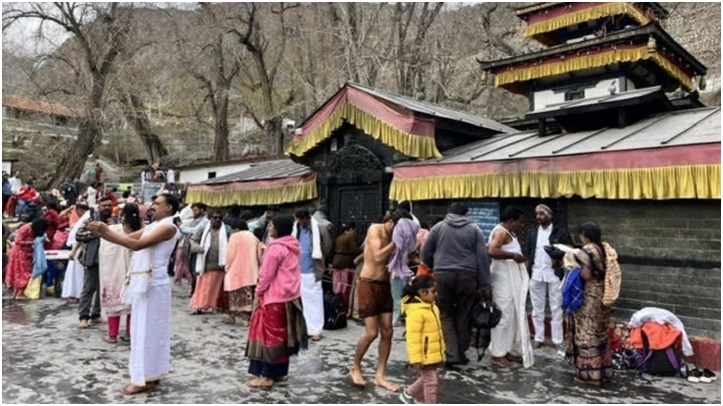
On a recent afternoon, the trails leading to the famous temple of Muktinath in Mustang remained filled with Indian pilgrims. Several frail, senior citizens were being transported to and from the temple uphill on wooden Palkis carried by groups of local men.
The temple premises were filled with mostly Indian tourists – a bulk of them visibly from the southern states like Telangana and Tamil Nadu. At the bus stand below, several groups of Indian pilgrims were enjoying their vegetarian meals such as Dosa and curry. Not that the area doesn’t have eateries offering vegetarian or South Indian delicacies. Yet there were few takers.
“Indian tourists are very important for this region; they are the backbone,” said Shakti Lal Juharchan, a hotelier in Marpha, Mustang, as he stood at the gate to welcome a new group of tourists who had just arrived.
He and other Mustang entrepreneurs are grateful for Indian Prime Minister Narendra Modi, who visited Muktinath in 2018, and other senior Indian leaders and officials who visited in the following years – for further popularising Muktinath as a must-visit pilgrimage destination for both Hindus and Buddhists in India.
Meanwhile, calls are growing in Pokhara and Kathmandu to open more vegetarian facilities for Indian pilgrims, some of whom are seen cooking their own meals along the way. This comes after several pilgrims were trolled on social media for cooking on the roadside.
Pokhara city’s mayor Dhan Raj Acharya has called for calm, urging everyone to respect all the visitors and their cultures.
“Please respect all visitors and pilgrims who cook and eat on roadsides while travelling,” he told a public gathering this week. “Our parents too do the same when they go on pilgrimage to India. It is part of our culture to make sure that we eat vegetarian and we eat pure and prefer our food from home.”